





When communication infrastructure fails, grid operations become a challenge. Faults, natural events or large-scale outages can lead to communication networks being overloaded or unavailable. At the same time, the need for coordination between control centres and field teams increases.
Mobile emergency communication solutions in the form of portable case systems provide a remedy. They enable rapid, temporary connectivity – independent of existing infrastructure – ensuring that utilities remain operational even in critical situations.
The effectiveness of mobile emergency communication for utilities depends heavily on the underlying networking technology. At the core of every system is the router, acting as the communication interface between field operations and the control centre. It determines whether connections remain stable, secure and continuously available under demanding conditions.

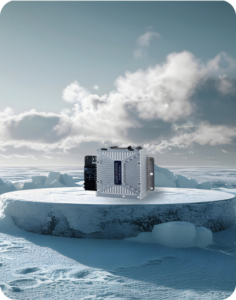
Mobile emergeny solutions ensure a stable connection in the event of a crisis – with the router at the heart of the system.

Multi-network connectivity and standard devices instead of expensive, inflexible handheld systems.

IP-based communication enables efficient operations in the field.

Challenges
- Limited and delayed operational readiness in the field: Field teams often lack access to central systems, data or control functions. At the same time, solutions must be deployed rapidly. Complex setups and missing connectivity delay coordination and hinder time-critical decisions.
- Failure of communication networks: In critical situations, communication networks may become overloaded or completely unavailable, disrupting coordination between control centres and field teams.
- Dependence on single communication networks: Relying on a single connection creates a single point of failure. If that network fails, communication breaks down entirely.
- Dependence on proprietary handheld systems: Digital radio solutions often rely on specialised push-to-talk devices, typically provided by a limited number of vendors.
- High security requirements: The transmission of sensitive operational data requires secure and tamper-proof communication.
- Harsh environmental conditions: Mobile emergency communication systems are frequently deployed in demanding environments, including extreme temperatures, moisture and mechanical stress.

Solution
- Independent mobile emergency communication in critical situations: By combining LTE 450 and Wi-Fi, with optional support for standard LTE or satellite communication, multiple communication paths are available.
- Reliable connectivity and rapid deployment: The router enables stable communication between the field and the control centre, while preconfigured systems and flexible interfaces allow for fast setup.
- Reduced dependence on individual networks: Supporting multiple communication technologies increases resilience and minimises reliance on a single network.
- Use of standard end devices via Wi-Fi: Commercial off-the-shelf devices such as smartphones, tablets and laptops can be integrated directly.
- Secure and energy-efficient data transmission: Support for established security mechanisms combined with low power consumption makes the solution suitable for battery-powered deployments.
- Rugged design for mobile deployment: Industrial-grade routers with extended temperature ranges, wide input voltage support and vehicle certification ensure reliable operation under harsh conditions.
Benefits for Utilities
Cost advantages by avoiding specialised hardware
- Using standard end devices reduces dependence on expensive, proprietary communication equipment.
- KPI benefits: lower acquisition costs; reduced spare part costs; improved scalability
Future-proof mobile communication infrastructure
- The solution is based on widely adopted technologies such as mobile networks and Wi-Fi.
- KPI benefits: lower obsolescence risk; higher investment security; reduced replacement cycles
Fast and coordinated field operations
- Immediate, stable connectivity allows field teams to access central systems and coordinate efficiently with the control centre, even under time pressure.
- KPI benefits: faster response times; quicker decision-making; improved operational efficiency
More than voice communication
- IP-based mobile emergency communication enables not only voice but also data exchange and application access.
- KPI benefits: more efficient workflows; better decision-making; improved data availability

Technical Insight
- Reliable operation under extreme conditions such as temperature fluctuations, vibration and mechanical stress.
- LTE 450, 5G RedCap and an Ethernet-based LEO satellite uplink — such as Eutelsat OneWeb, Starlink or Amazon Kuiper — can be operated in parallel, with instant failover between communication paths.
- Low power consumption — typically between approximately 4 and 18 watts, depending on configuration — enables battery-powered and off-grid deployments.
- Model-dependent input voltage ranges of 12–24 VDC, 12–30 VDC or 12–60 VDC support standard DC supplies, vehicle electrical systems and industrial battery setups.
- Multiple VPN options — including IPsec, OpenVPN and WireGuard — configurable in line with BSI TR-02102-3, combined with TACACS+ and RADIUS for centralised authentication.
Why Garderos
Long-term investment security:
Product lifecycles of at least 15 years and long-term availability reduce the need for costly replacement cycles.
Security architecture for critical infrastructure
VPN, firewall and certificate-based authentication aligned with BSI and NIS2 requirements.
High availability for blackout and fault scenarios
450 MHz, watchdog mechanisms, multi-WAN and self-healing features ensure communication continuity even under extreme conditions.
Reliable under harsh operating conditions
Robust, industrial-grade design for mobile deployment — developed for changing environments, transport and field operation.
Our Clients








Further Information
What routers does Garderos offer? What software capabilities does Garderos provide?